


I walked into the classroom to teach my first developmental math class excited to help students brush up on algebra and get them fired up about careers in STEM. But I quickly realized that the students were lost and completely uninterested in math. That was 11 years ago.
I had just finished a stint doing top-secret work for the National Security Agency. There, we never looked at a problem and said, “Oh well, I guess we can’t solve that one.” We thought outside the box. And that was what I was determined to do with these students.
I was teaching in the community I grew up in, one that I deeply cared about, as part of the summer bridge program at San Diego State University’s Educational Opportunity Program.
This program helped refine my teaching strategies, both for students starting a two-year college and for those entering a four-year university. My goal was to increase the students’ self-confidence and maybe even get a few who thought they were “just not a math person” to major in STEM fields.
I brought in what I thought was a fun activity using origami paper, scissors, and glue to explain fractions. But something about either the concept or my delivery fell flat. So I pivoted and took the class outside with some sidewalk chalk, tasking the students with factoring problems under the San Diego sun.
That didn’t go much better.
So I asked the students about themselves and their goals. I showed them that I wasn’t there just to talk, but also to listen.
My longtime side gig as a DJ led me to another idea. As I watched a friend spin records late one night, I noticed that he likes to ratchet up the tempo of the songs he is playing to get people to dance. On the left deck he was playing a track that, sped up 8 percent, was 135 beats per minute. Looking for a track to put on the right deck to mix with the song he was playing, he went for another track, which, when sped up by 8 percent, would match the 135 beats per minute on the left deck.
The next day I brought a turntable to class. I explained to the students that we were going to listen to fractions and percentages. I put a 45-rpm record by Beyoncé on the turntable and slowed it down by 26 percent by playing it at 33 1/3 rpm. At that speed, it hardly sounded like Beyoncé at all. I asked my students what we were listening to, and one said, “Beyoncé, but it doesn’t sound like her; she sounds slow.” Another student said, “chopped and screwed,” referencing a hip-hop genre that partly involves slowing down the speed of a song. Both were correct.
If you take a 45-rpm track like Beyoncé’s “Irreplaceable,” which has 87 beats per minute, and slow it to 33 1/3 rpm, or by approximately 26 percent, the song, at 64 beats per minute, will sound nearly unrecognizable. I talked about this number, 26 percent, with my students, noting that it is the interest rate of some credit cards. We compared 33 1/3 rpm to 0.5 percent slower or faster; my students could barely notice the difference. I told them that the interest rate on many savings accounts is 0.5 percent, or even lower.
Students were listening. Their heads were no longer planted on their desks with eyes closed. They had their hands up, and the whole mood of my class went from dread to genuine excitement. As one of those students recently said in a podcast interview, “He comes in with really, really unique ways of teaching, and I’m not even paying attention to the fact that I’m actually learning through this.”
I called it hip-hop math, and I infused the course with music all summer long. I gradually made the problems harder, asking students to explain their steps to one another. I had students work on problems on whiteboards, chalkboards, and even Post-it notes. I had them reflect on their newfound confidence. Students were repeating lines from the rapper Nas to stay motivated, with once-quiet students loudly saying, “I know I can/Be what I wanna be.”
A few students thanked me for trying so hard to make math fun for them, but mostly they were proud of themselves. And I was proud of them, too.
As a math professor at San Diego City College, I continued to refine my approach. I learned that there are communities of educators focused on making their teaching more accessible to students. I was invited to the Umoja Summer Learning Institute, where I learned culturally responsive teaching practices rooted in African and African American intellectual traditions. I continue to learn from colleagues, whose classes I visit to see what is working for them.
Not everything I have tried has worked, but I keep at it.
Tapping students to teach
One key practice is that I have increasingly invited my students to be part of the teaching in addition to the learning. In fact, every student in my class is expected to be both a learner and a teacher.
For one thing, every student serves as a tutor. Many of the students say that helping their peers with questions that they recently struggled with showed them that they really could do math. Neurodiverse students who struggled with math found themselves deconstructing and reconstructing problems as they tutored their peers. Those tutoring experiences proved to them that they can do math.
I also challenge students to make video lessons in their preferred language, an approach I borrowed from Karla Rojas. One group of students filmed themselves in front of a whiteboard teaching standard deviation in Somali. Besides translating lessons for peers who also speak the language, the videos convey a sense of pride students have in sharing their culture. It turns out there is not a Somali translation for “standard deviation,” so they improvised.
I intentionally evoke all five senses to draw students in and make lessons memorable. In traditional lectures we somehow focus on only two senses, sight and hearing. I’ve created several lessons based on my interest in cooking—I was previously a sushi chef—that incorporate touch, smell, and taste, as well.
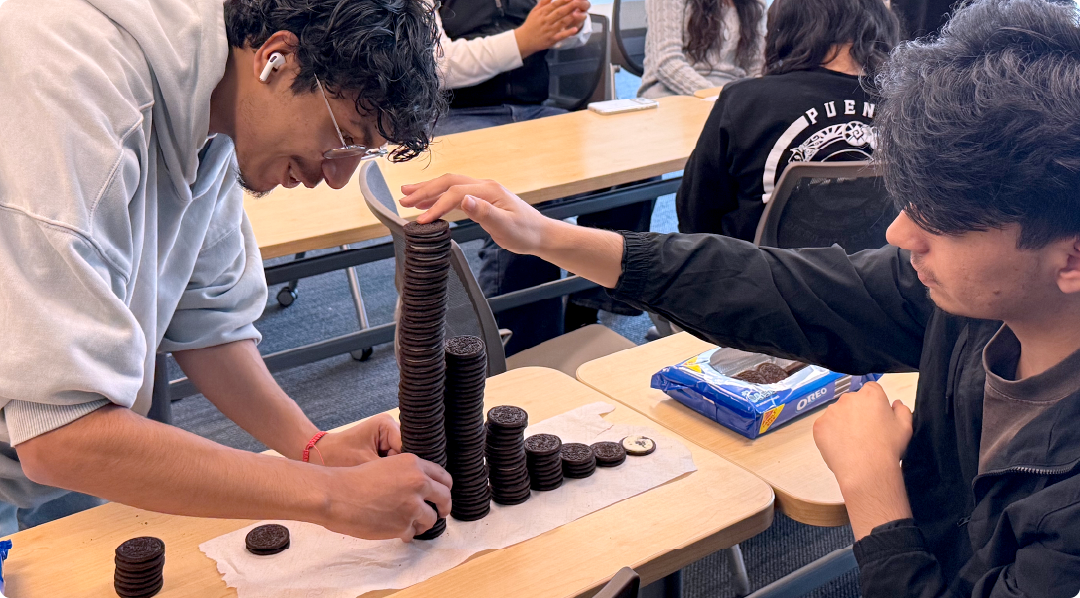
As one example, I have students do an “Oreo challenge” of building the function 2^x starting with 2^-1, or half an Oreo, doubling that to one Oreo, then doubling to two Oreos, and so on. The highest any student has ever free-stacked Oreos is 2^5—or 32 cookies—and only for about 30 seconds, since the irregular shape of the cookies makes it a challenge. But students get very creative and try things like removing some of the filling to use as glue between the Oreos, or rotating the cookies to level out the surfaces.
In my online classes I ask my students to draw a function by cutting Post-it notes into strips or by using ketchup, mustard, mayo, Sriracha sauce, or toothpaste from a squeeze bottle. Some students place their power cords on top of the rectangles. One student untied their shoes on Zoom and had their shoelaces act as the continuous function. Let’s not put limits on students’ creativity and motivation to learn.
These approaches are working. I taught the lowest level math course in UC San Diego’s summer bridge program for four years. Each year, 80 to 100 percent of my students tested into a higher course, regardless of how far back their deficits went. Some professors tell their math students to look to their left and right on the first day of class, and note that not all of their cohort will be there at the end of the term. That approach is antithetical to my job as an instructor.
Success stories from students past fuel my current students to succeed. I start every course with students from previous semesters discussing their successes in math despite their initial struggles. Students who reclaimed their math confidence in my class share stories about tackling math while caring for little ones; working to support themselves and their family; or dealing with food insecurity, housing concerns, or mental health issues. They talk about succeeding in math despite learning disabilities.
I also share my own story with students. About how I stopped going to school in 10th grade because of gang violence and instead pursued a GED diploma at Centre City Adult School. And then how I majored in mathematics at San Diego City College despite having only a ninth grade math education, all while washing dishes at a restaurant and bagging groceries at a Vons supermarket. And how I graduated from SDCC and transferred to San Diego State University, where I earned a bachelor’s degree in mathematics, before going to Auburn University and earning both a master’s and a doctorate in discrete mathematics. I tell them about all the professors along the way who believed in me so strongly that I started to believe in myself.
Stories from former students show my current students that passing my class can help them reclaim their confidence, resulting in life-changing impacts on their academic journey. It’s about empowering students who have received the message that they aren’t expected to succeed. They learn that the you’re-not-a-math-person message was a lie. And that opens possibilities well beyond numbers or course completion.
Stories matter. More than math itself, community matters, building confidence matters, mental health matters, snacks matter, high expectations and high support matter, having students tutor their peers matters, culturally relevant math matters, and learning through multiple senses and in multiple ways matters.
My message to students is that math does not have to be a barrier—math can be liberating, and math can open doors.
My message to other educators is that we need to focus not on whether students are ready for advanced math but on whether we have made our classrooms ready for the amazing students we already have.
Roberto Rubalcaba is a mathematics professor at San Diego City College. He is also a DJ and sushi chef, teaching math through hip-hop, art, sushi, and dance.
For more insights on the role of math in ensuring educational equity, subscribe to Just Equations’ newsletter.
