


Many colleges go to great pains to make sure students get placed at the right level in mathematics. And with rising concerns that students aren’t ready for calculus and other high-level math, some colleges are opting for more guardrails, structure, or remediation to ensure that students are placed appropriately and succeed in their first math course in college.
So an approach that we’re trying at California State University, East Bay, where we allow students to choose their own math placement, could seem like a recipe for disaster.
Wouldn’t most students just choose the highest course possible so they can finish the requirements, only to fail due to lack of preparation? Would incoming freshmen have enough information about the content, pedagogy, and support in college courses to make an informed decision?
As we have piloted the model over the past two years, however, we’ve proved those concerns overblown. Instead, we’ve seen wins for students and clear improvements over the standard method. And we think this counterintuitive approach deserves a closer look at all kinds of colleges around the country.
For our guided self-placement program, we first aimed to create a spirit of partnership between students and faculty, with the goal of making the placement process more transparent to all involved.
Previously, placement decisions were based on a quantitative multiple-measures assessment, or MMA, that considered high school GPAs (mathematics and overall), high school coursework, and available standardized test scores. It is still used for the courses involving entry-level math for STEM fields, to determine which of three courses students should start with: College Algebra With Extra Support, Precalculus With Algebra, or Calculus I.
This approach leaves out a key variable, though. It does not account for students’ perceptions of their readiness or their prior experiences.
Through teaching and conversing with students, we heard an important recurring concern: some students placed into College Algebra felt the course unnecessarily repeated material they had already mastered. This observation suggested that placement decisions could be strengthened by incorporating structured opportunities for students to reflect on their preparation and discuss their options with knowledgeable faculty or students.
By the time we pursued this effort, we had already successfully redesigned our Calculus I class. After adopting active learning, coordinating the course across all instructors and, and launching an instructor community of practice, our student outcomes in calculus improved. The proportion of students earning a D or F or withdrawing from the course fell from about 30 percent to less than 16 percent in recent years. But we hadn’t addressed placement.
So we set up our guided self-placement program with two phases of engagement. First, students complete a questionnaire that includes self-reporting their mathematics experiences and rating their perceived comfort with content-specific questions. Students are then invited to participate in a one-on-one meeting with a self-placement representative to further discuss course placement before deciding which course to enroll in.
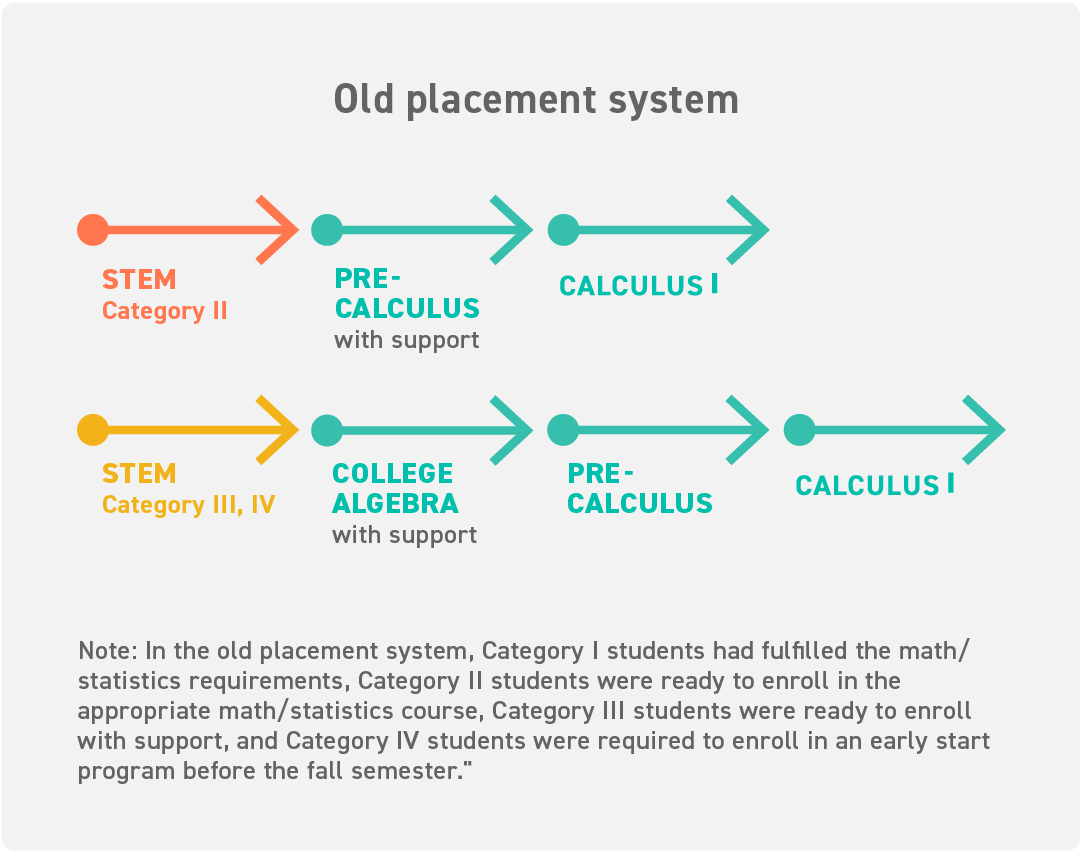
As we dove in, we learned that students often lacked the information and guidance needed to make an informed placement decision—so we designed a process that provided both. Our goal was to clarify why students may be placed into particular courses and how those courses fit together to form a pathway.
As a starting point, we created resources explaining the topics and how they all fall in a sequence, and these were used during one-on-one advising sessions with students. Students then received an email introducing the opportunity to choose their math course. All students completed a questionnaire, starting with an option to either self-place or accept automatic placement.
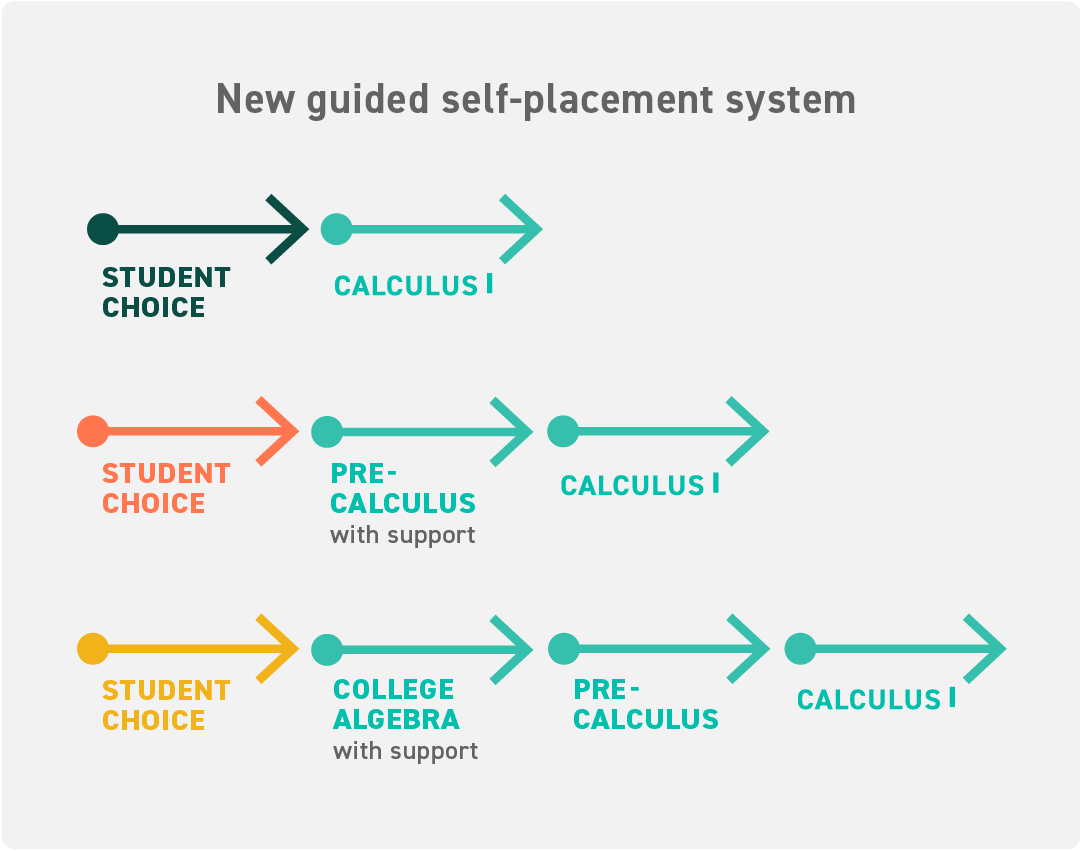
As the pilot expanded, we sought to make the most of the individual advising meetings by using them not only to discuss course placement, but also to introduce students to the academic support systems available in each course, including the STEM Lab, learning assistants, and tutoring. Familiarizing students with these resources before the semester began helped ensure that they knew where to turn when they encountered challenges. The meetings also allowed us to emphasize the mathematical practices and problem-solving skills associated with success in each course, rather than relying solely on a checklist of topics students were expected to have previously encountered. For Calculus I, examples included “working confidently with functions” and “applying functions to model/solve problems in context.”
Most surprisingly, we discovered that, for many incoming students, this advising meeting was their first conversation with someone at the university. What began as a course-placement discussion also became an important early opportunity to welcome students, answer questions, introduce sources of support, and communicate that their success mattered to the institution.
So did the students just choose the highest placement?
Nearly half of the students in our pilot chose the placement that the MMA assessment recommended, while most of the other half chose a higher-level course.
Even when the students chose the same path they would have been placed in, most expressed appreciation for the process—how it clarified their options and gave them ownership in choosing their pathway.
As one of the professors who advised students in the pilot shared: “We were only supposed to meet for 15 minutes, and [the student] ended up staying for I think over 30 minutes just to talk about the math classes and everything like that. He was so excited just to have someone to talk to and also to have some control.”
Students also said they liked the opportunity to make a choice based on their experience—although not every student felt that they required a one-on-one meeting to come to a decision. These takeaways helped to inform several changes made to the first wide-scale deployment of the program the following year.
So was self-placement worthwhile in our institution?
The impact of this deployment of guided self-placement yielded promising results. For instance, 43 of 192 (22 percent) of first-year STEM majors in the pilot program took at least one fewer mathematics course that they would have had to take in the old placement system. This saves our students time and money without sacrificing rigor. Students also reported that their coursework was more relevant to their majors and career earlier in their journey—thus lowering barriers and improving student success.
Meanwhile, pass rates for students who chose to self-place were very high: 19 of 21 students (90 percent) who participated in self-placement passed Calculus I, compared with 95 out of 117 students (81 percent) who were placed by traditional methods.
A model approach
Other colleges that have tried similar self-placement approaches have seen success as well. At Las Positas College, students complete an online questionnaire through the student portal, self-reporting their high school mathematics coursework and GPA, after which the system determines whether a corequisite support course is required, recommended, or optional based on California’s default placement guidance. Students whose circumstances do not fit the standard decision tree meet with a counselor to determine an appropriate placement.
We couldn’t have done this alone. Our self-placement framework was developed through our department’s participation in the NSF-funded Achieving Critical Transformations in Undergraduate Programs in Mathematics project, a multi-institutional initiative supporting departmental change through networked improvement communities. The idea and approach emerged from a team of undergraduate and graduate students alongside faculty across ranks after reviewing data and researching possibilities.
In the monthly community of practice meetings, instructors also shared teaching practices, discussed student needs, and sought to strengthen inclusive teaching, assessment, and proactive outreach. This model helped to create consistency across sections, allowed instructors to adapt the common materials, and ultimately supported students participating in self-placement.
Our experience suggests several important lessons for institutions seeking to improve mathematics placement.
First, students are willing to take an active role in determining their placement when they are provided with structured opportunities to reflect on their preparation. Students consistently expressed a desire for more information about math courses, including the topics covered, expectations for success, and how each course factored into their academic pathway.
Transparent descriptions of course content and sequencing—along with multiple opportunities and reminders to access this information—helped students better understand the implications of their placement decisions.
It is important to remember that the transition to college is an anxious period for many students. Sometimes students participating in a general orientation might not get answers that are specific enough for their cases or backgrounds. This is where the departmental-level connection can help. Providing opportunities to speak with a knowledgeable faculty member or peer helped students feel more confident about their decisions and reduced uncertainty surrounding course selection.
Finally, self-placement reinforced the importance of recognizing students as experts on their own educational experiences. Students are uniquely positioned to reflect on what they remember, when they need additional review, how long it has been since they studied particular topics, and the level of challenge in which they are most likely to succeed.
Combining this self-knowledge with clear information about course expectations and supportive advising resulted in a more student-centered placement process that worked better for the institution, and for the students.
Jesús Oliver is a professor of mathematics at California State University, East Bay, where he works to improve student success and equity in undergraduate mathematics. His work focuses on building community, infusing active learning in the classroom, and developing departmental systems that support students and instructors.
Sagar Shah is a lecturer in the department of mathematics at California State University, East Bay. He developed an interest in mathematics education during time spent as a college mathematics tutor following earning his Bachelor of Science in physiological science from the University of California, Los Angeles.
For more insights on the role of math in ensuring educational equity, subscribe to Just Equations’ newsletter.
