



Ten years ago, Compton Unified School District was failing. The graduation rate was only 60 percent, and the school district was fighting a potential takeover by the state for fiscal reasons. Most students weren’t prepared for work in college and beyond, with only 23 percent passing courses certified as meeting A–G requirements, which are necessary for students to gain admission to public universities in California.
As school leaders—I have been the district’s executive director of college and career readiness for the past 10 years—we saw a path to a solution: increase access to rigorous coursework to ensure college and career readiness, and focus on student outcomes instead of the needs and wants of the teachers and staff, which too often feel like they come first.
We know that graduating from high school and gaining admission to college is not enough. Students need to be prepared for both college and career. In our district college and career department, the notion of “to and through” is our North Star.
A decade ago, only the students at Compton Unified considered to be the best and brightest were taking honors, Advanced Placement, and dual-enrollment college courses. The data reflected this tracking: Despite there being more than 5,000 students in our district, only a few hundred were taking an AP class.
Our belief was that, in order for them to be prepared for life after high school, more students needed to be challenged. So we stopped limiting our students to the track they had been placed on way back in elementary school. We used multiple indicators to find students who might do well in AP and other college-level courses, looking beyond standardized test scores and including metrics such as grades, which have proved to be stronger indicators of success.
In fact, we felt that solely relying on standardized tests such as the PSAT and AP Potential would hinder our efforts to support all students who could benefit from AP and college courses. That’s because AP Potential’s methodology focuses only on the probability of a student passing the AP exam, with no consideration of what that student could learn from taking and passing an AP course.
Our theory was that these more challenging courses would improve academic self-efficacy, benefiting students as they continue their journey to and through college and career. And our data show that students who take the AP courses do better in college, no matter what they score on the exam.
Nothing happened overnight. We made changes gradually, increasing advanced offerings each year.
Our first step was to review the courses we had: In some cases, our courses met the A–G standard, but no one had gone through the process of getting the courses certified. It took us two years to certify all courses, including our math courses, as A–G.
Soon after, we began noticing that the number of students meeting their A–G requirements increased at all campuses. Our school sites began seeing the fruits of their labor, and excitement grew knowing that our students could achieve, just like students at other, “higher performing” schools. In fact, friendly competition began brewing among our sites, with counselors comparing their results with schools in and outside of the district.
By the end of the 2018–2019 school year, Compton saw the rate of students completing the A–G set of courses, qualifying them for admission to the UC or CSU system, increase to 43 percent, up from just 23 percent in 2013–2014.
Nevertheless, this meant that the majority of students, or nearly 60 percent, were still not eligible for admission to public universities in California. Therefore, we decided that it was time to require students districtwide to complete the A–G requirements, starting with the class of 2024. This means that all students have to complete three years of math, including Integrated Math I, Integrated Math II, and Integrated Math III.
Despite the logistical challenges of the pandemic—such as Chromebook distribution, figuring out Zoom, and how and when instruction was going to resume—we made the changes. And as more students took these college-prep courses, graduation rates went up as well.
While not required by A–G or district policies, we knew it was important that students also take a fourth year of math to be prepared for college, so we strongly encourage that. Today, 90 percent or more of our seniors enroll in this optional fourth-year math course.
Our district also partnered with nearby Compton College and began implementing dual enrollment across all of our high schools, recognizing the value of earning college credit while still in high school. As a result, Compton Unified saw an increase from 23 college courses being taken in 2015 to nearly 4,000 last year.
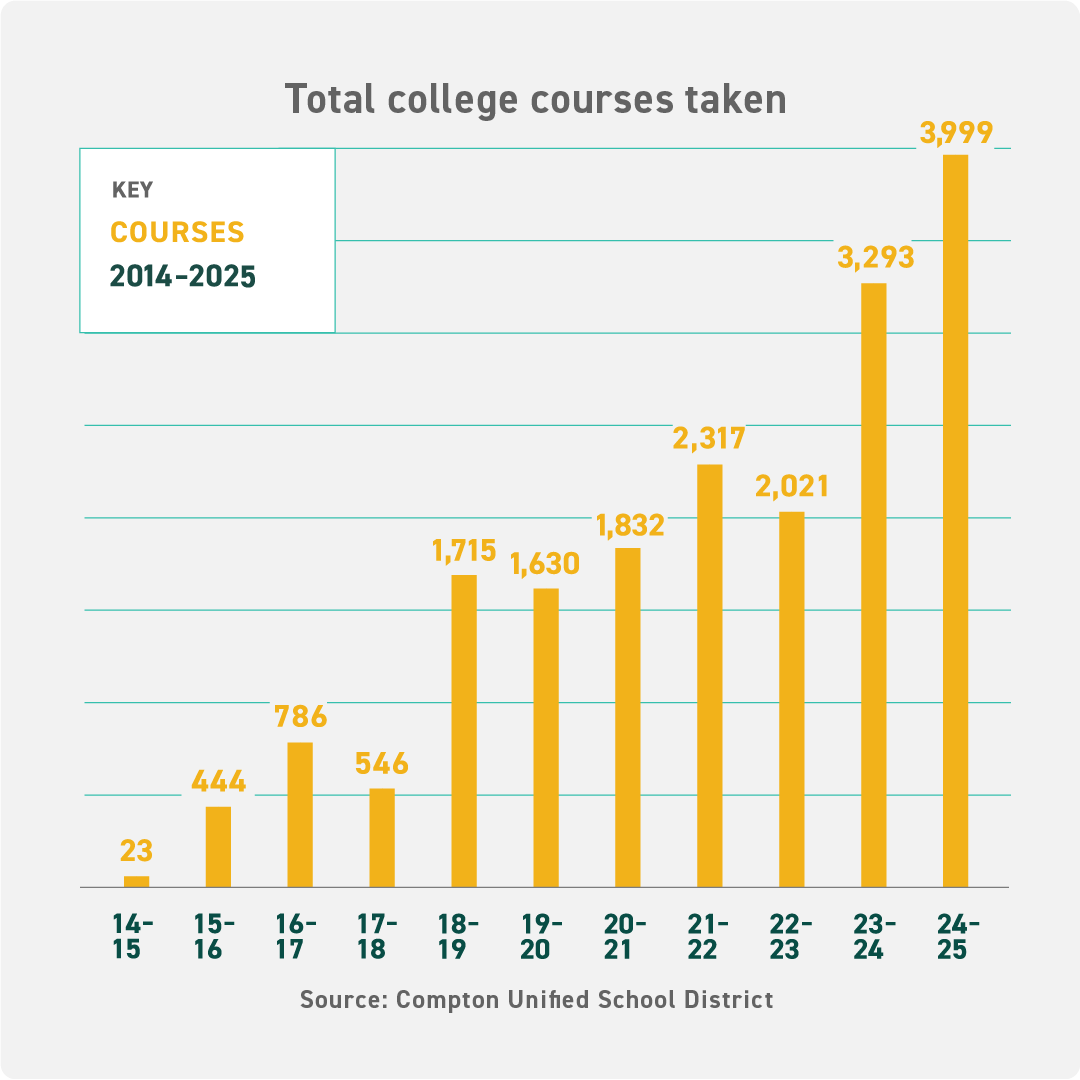
As we raised our expectations of students, we saw school cultures change, too. More students were taking AP and college courses, which led to more students being admitted to college. And we saw a nearly 25 percent increase in students enrolling in four-year universities, with a comparable decrease in enrollment at two-year institutions. As these numbers rose, more teachers and leaders believed in their students, who in turn believed in themselves.
The graduating class of 2025 achieved historic outcomes never seen before in the Compton Unified School District: 94 percent of students graduated, a 34 percent increase over 2015. Similarly, 95 percent were admitted to college, and we sent more of our students to UC and CSU campuses than other similar school districts did.
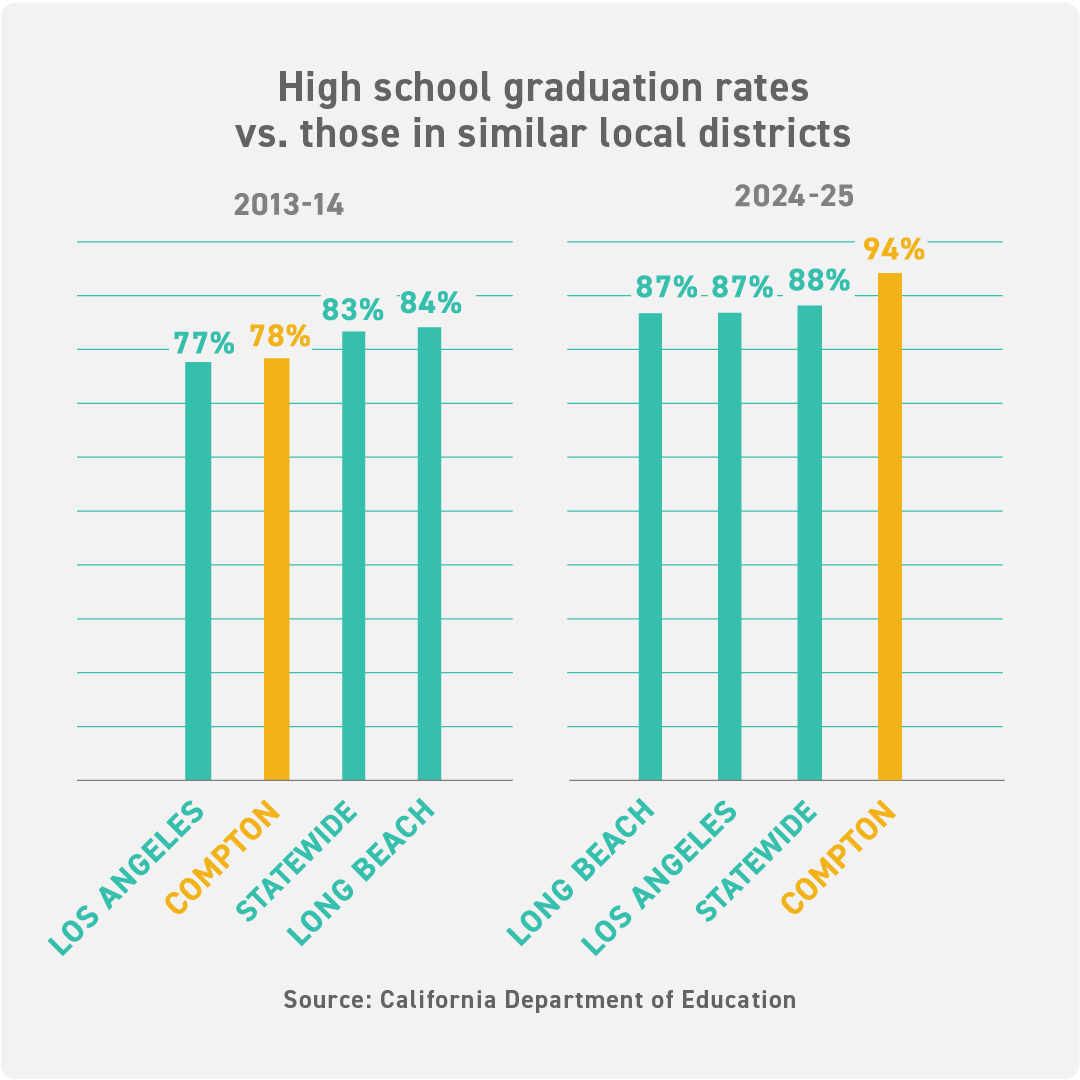
One school in particular, Dominguez High School, boasted an A–G completion rate of 96 percent, the highest in the state for schools that are not magnet schools or charters with admissions requirements.
The Compton Unified School District achieved these results despite having 95 percent of its students classified as socioeconomically disadvantaged. Compton has received numerous awards, including AP School Honor Roll, California Exemplary Dual Enrollment Award, the Magna Award Grand Prize, a CSBA Golden Bell Award, and the National Postsecondary Strategy Institute’s Power of Hope Award.
In my experience, change in schools ultimately comes through being able to measure outcomes so educators and leaders are held accountable. So we set up dashboards and encouraged measurement and a data-driven approach to our policy changes.
Strong, consistent district leadership also played a significant role. The current superintendent, Darin Brawley, is beginning his 14th year in Compton, an unusually long tenure. Similarly, the majority of board trustees members have remained the same during his tenure. While many districts during this same time period have seen changes in vision, direction, and leadership, this group has put sustained focus on student outcomes, including college and career preparation.
The turnaround in Compton shows the importance of college and career efforts in boosting student readiness in math, as well as other subjects. Districts often make the mistake of leaving this work to personnel, who lack experience in this field. Because relatively few school counselors advance into administrative leadership, many district leaders have had limited formal preparation in this critical area.
We can no longer afford to treat college and career readiness as an ancillary function rather than a core component of a student's educational experience. When districts invest in knowledgeable leadership, coherent systems, and sustained support, they create opportunities that fundamentally change students' lives and strengthen the future of their communities.
Jorge Torres is the executive director of college and career readiness at Compton Unified School District.
For more insights on the role of math in ensuring educational equity, subscribe to Just Equations’ newsletter.
