


.png)
At too many colleges and universities, the undergraduate mathematics curriculum is awkward and uninviting: too advanced for many high school graduates to access; too rigid to adapt to the needs of today’s rapidly changing world. It has become out of touch with the interests and inclinations of the typical post-pandemic, Gen Z student.
But the rise of artificial intelligence could ignite an excitement about math similar to that triggered when the Sputnik satellite was launched in 1957.
When Russia launched the world’s first satellite, it sparked an unprecedented push for math education in America in a space race that captured the public imagination. The next year, President Eisenhower signed into law the National Defense Education Act, which injected more than $1 billion to schools to bolster mathematics, science, and foreign language instruction. High schools around the country quickly set up courses in trigonometry and calculus for younger students with a clear goal in mind: to create a pipeline of future engineers and scientists needed to advance the space program.
Today, America finds itself in a new technological race, this time over the development of AI. Though this technology brings a mix of promises and challenges, we argue that it is time for a new national push in math education.
In fact, more than any other academic environment, the mathematics classroom—from preschool to grad school—should be the center of exploration, experimentation, and innovation around AI and data science.
Since 2022, the mathematics and statistics faculty at California State University, Long Beach—your authors included—have been on a journey to change our approach to math education: working across K–12, college, and employers to create classroom, research, and outreach experiences to define the way our region views mathematics and its relevance to students and our local communities. Through grant-funded projects, we have focused on helping students see how data science and math can be used to solve real-world problems and build skills that can lead to meaningful careers.
This work involved changing part of our department’s math and applied statistics curriculum, with the goal of expanding access to STEM. That meant removing a requirement that students take a three-semester calculus sequence before moving to courses such as Introduction to Data Visualization and Data Mining. Instead, students take specifically designed calculus courses alongside the data science courses. And we have introduced a major in data science, as well as a minor in data science and AI.
In our courses, we incorporate practical research questions with real data. Our goal has been to shift the motivation of our teaching to discovery and exploration, without compromising mastery and completion, so that students experience the content as scientists would. When possible, the questions students are trying to answer using data center on their daily lived experiences, so that they see the relevance of mathematics.
Opportunities for students to engage in research have been shown to increase student achievement and persistence, as well as the likelihood of a student pursuing a graduate degree. These benefits are particularly important for students of color, whose attrition in STEM programs is well documented.
One such example is the four-month data science research experience that we have offered twice over the last three years. It includes collaborative teams of students and educators from universities, community colleges, and high schools. We match each team with a nonprofit or industry partner in the community and have graduate students and faculty members serve as both mentors and collaborators. The goal is to involve students from diverse backgrounds on projects that support local communities in need, particularly in areas with large underrepresented and underserved populations, such as Long Beach and Compton.
For example, one team partnered with Books & Buckets in Long Beach, which supports local young people through basketball and programs for low-income K–12 students. The students investigated food options in the Washington neighborhood and, after analyzing the mapping data and national definitions, identified the area as a food desert. They then worked with the nonprofit and the city to explore setting up traveling farmers markets.
Another team partnered with the Center for Health Equity Research in Long Beach to engage researchers and community partners in conducting public health research and program evaluation. The project investigated the associations between disordered sleep and diabetes outcomes, and the findings have informed the work of the center. The students’ work underscored the need for integrated mental health and food assistance interventions to prevent substance use among vulnerable populations.
This service-learning approach allows students (and faculty) to learn and apply their skills in a meaningful context, promoting both academic and community engagement. It also helps participants understand the impact that data science can have on local communities, by providing invaluable information.
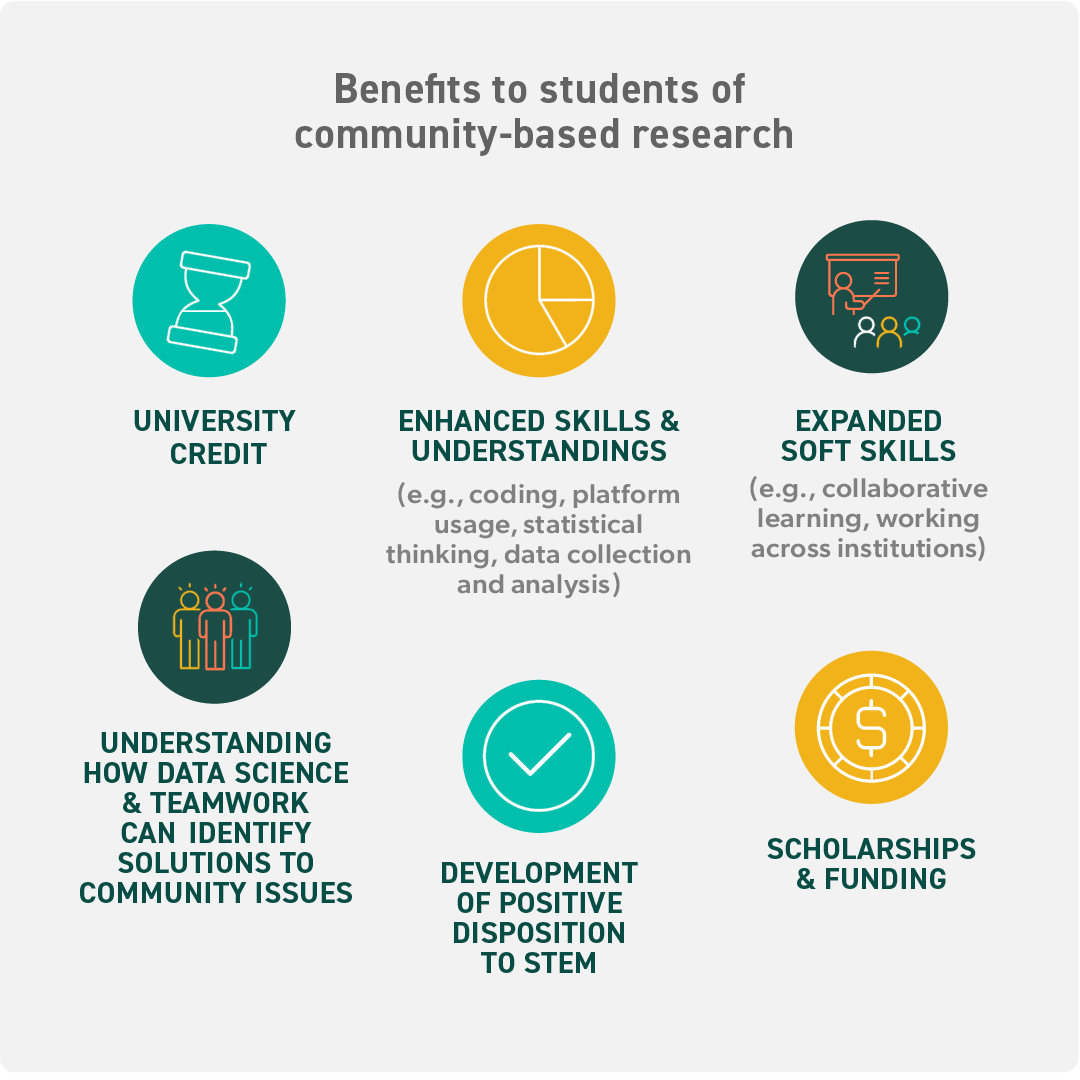
Research-team students from Cal State Long Beach, many of them majoring in statistics or related areas, said that most of their prior academic work in the field had been theoretical, with little clear application to daily life. They were excited to engage with the community. As one student noted in a survey about the experience, “I wanted to be a part of something big that can help a community and change a part of Long Beach that may impact people’s lives.”
We have also sought to broaden interest in math and STEM fields through outreach efforts such as Data Day at the Beach. At this daylong annual event for students, families, educators, and local partners, participants learn about real-world uses of data science and AI through direct connection to industry professionals, including breakout sessions and an industry panel. Students learn about a range of topics in hands-on coding sessions, including data visualization, predictive modeling, prompt engineering, and how to use agentic AI with GitHub. We have had employees from Apple, Microsoft, Children’s Hospital Los Angeles, NBCUniversal, Sega, and other major tech companies serve on our Data Day panels and lead sessions; it shows our community that they too can aspire to these positions. The goal is to expose our students to what data science is, how they can work as data scientists, and what these types of jobs entail.
Currently, we are in the process of developing a formalized internship pipeline for our department with committed partners, explicitly connecting our students to industry and nonprofits they can learn from and contribute to upon graduation.
We are not alone in calling for these kinds of changes to mathematics education. This summer, Transforming Post-Secondary Education in Mathematics convened a summit, led by prominent thinkers in mathematics and statistics, that identified a path forward focused on making data, statistics, computation, modeling, and technology more central to undergraduate courses and programs and, importantly, communicating to students the social impact of mathematics.
Students today want to make a difference, and they prioritize immediate access to information for immediate impact, instead of learning more than is needed for longer than is necessary, just to say that they did it. And employers want students who can help them harness data and AI to reimagine the workplace. So educators need to communicate to students the value of math in meeting goals they care about.
That is what we have heard from students like Tavares Martin, a first-generation student at Yale University. He recently reached out to one of us after hearing us speak on a podcast, and he shared that he had to slog through theory-heavy math courses before he could get to the “good stuff” that got him interested in the field to begin with. Coming from an under-resourced school, Martin faced extra challenges and is still seeking guidance to help navigate a system that feels full of hoops. We have heard this same sentiment from students we teach.
As for employers, there is an opportunity to work more closely with educators as jobs change more rapidly than ever.
We need to modernize the math curriculum. We can transform traditional academic classrooms—both physical and virtual—into collaborative, inquiry-driven spaces where mathematics is used as an invaluable tool to aid discovery and thus unlock possibilities that once seemed impossible.
Babette M. Benken is a professor of mathematics education and an advisor at California State University, Long Beach. She is passionate about creating pathways that support access and success in STEM, as well as providing models for teacher education that integrate inclusive pedagogy and context-rich curricula.
Kagba N. Suaray is an associate professor of statistical science at the University of Toronto, following 20 years at California State University, Long Beach. His work reimagines math and statistics learning through culturally relevant, research-driven experiences that foster curiosity, belonging, and identity.
For more insights on the role of math in ensuring educational equity, subscribe to Just Equations’ newsletter.
